<?xml version="1.0" encoding="utf-8"?><feed xmlns="http://www.w3.org/2005/Atom" ><generator uri="https://jekyllrb.com/" version="4.3.2">Jekyll</generator><link href="/feed.xml" rel="self" type="application/atom+xml" /><link href="/" rel="alternate" type="text/html" /><updated>2023-02-19T14:05:25+00:00</updated><id>/feed.xml</id><title type="html">Nick Darnell’s Blog</title><subtitle>stuff</subtitle><author><name>Nick Darnell</name></author><entry><title type="html">ChatGPT Killed Fancy Game Namer</title><link href="/chatgpt-killed-fancy-game-namer/" rel="alternate" type="text/html" title="ChatGPT Killed Fancy Game Namer" /><published>2022-12-02T00:00:00+00:00</published><updated>2022-12-02T00:00:00+00:00</updated><id>/chatgpt-killed-fancy-game-namer</id><content type="html" xml:base="/chatgpt-killed-fancy-game-namer/"><![CDATA[<p>I’ve been playing with ChatGPT and it’s kind of incredible.  After toying with it for awhile a thought hit me, that this could replace something like Fancy Game Namer, my little utility for generating game names to assist in sparking ideas for Game Jams.</p>

<blockquote>
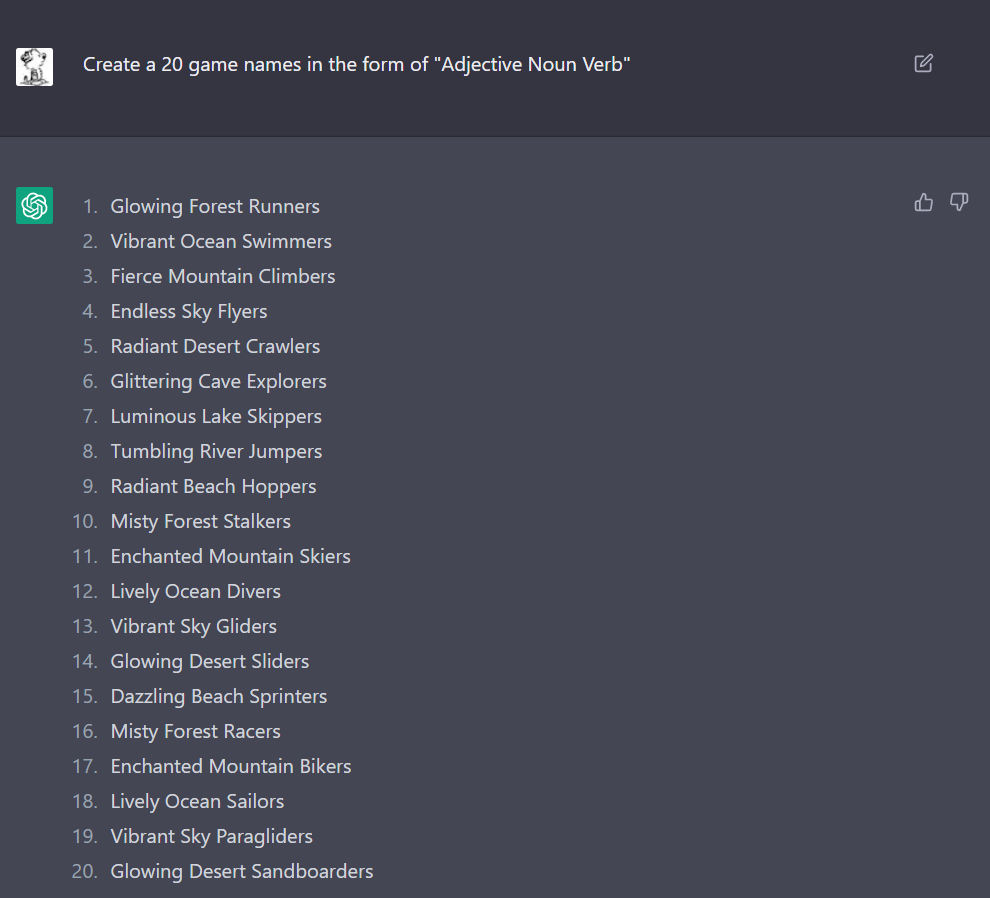
  <p>Create a 20 game names in the form of “Adjective Noun Verb”</p>
</blockquote>

<p><img src="/assets/images/posts/gamenames_chatgpt.png" alt="" class="full" /></p>

<p>Amazing - this is such an incredible tool for sparking ideas.  Writers block?  HAH!</p>]]></content><author><name>Nick Darnell</name></author><category term="game-jam" /><category term="ai" /><summary type="html"><![CDATA[I’ve been playing with ChatGPT and it’s kind of incredible. After toying with it for awhile a thought hit me, that this could replace something like Fancy Game Namer, my little utility for generating game names to assist in sparking ideas for Game Jams.]]></summary></entry><entry><title type="html">Debugging UFunction::Invoke</title><link href="/debugging-ufunction-invoke/" rel="alternate" type="text/html" title="Debugging UFunction::Invoke" /><published>2017-11-07T00:00:00+00:00</published><updated>2017-11-07T00:00:00+00:00</updated><id>/debugging-ufunction-invoke</id><content type="html" xml:base="/debugging-ufunction-invoke/"><![CDATA[<p>A few weeks ago Nick Penwarden highlighted <a href="https://www.unrealengine.com/en-US/blog/unreal-engine-improvements-for-fortnite-battle-royale">several improvements</a> that we made to Unreal Engine 4 while working on Fortnite Battle Royale.</p>

<p>One of the things that didn’t make the list above is a little debugging gem I added while working on Battle Royale. In Fortnite the team used a fair amount of Blueprint based Widgets, which means inevitably you’ll throw in a breakpoint in C++ but end up seeing a callstack like this when you’re looking for who is calling your code,</p>

<div class="language-plaintext highlighter-rouge"><div class="highlight"><pre class="highlight"><code>[Your C++ Code]
UFunction::Invoke(...)
UObject::ProcessEvent(...)
AActor::ProcessEvent(...)
[Rest of the stack]
</code></pre></div></div>

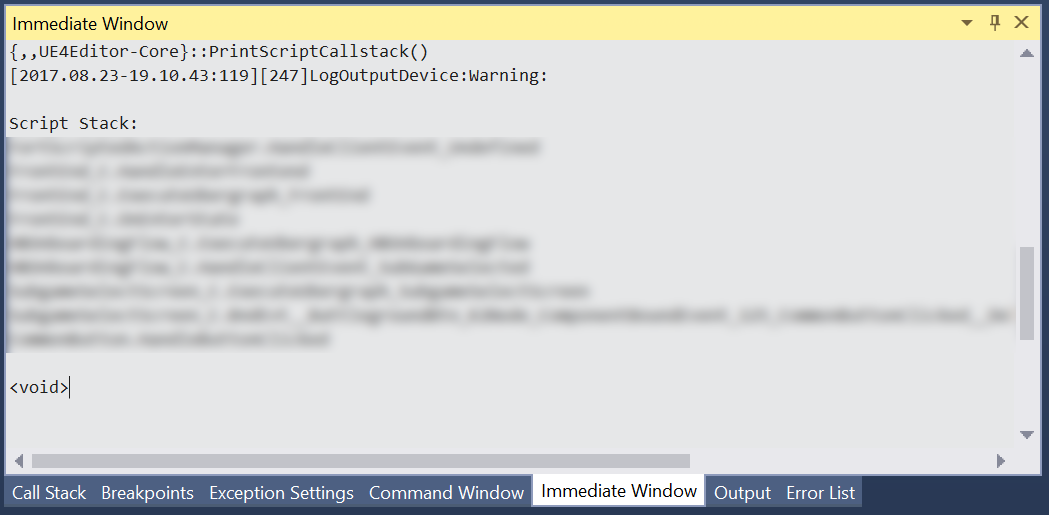
<p>I was working with a lot of code in Fortnite I was unfamiliar with, so it wasn’t always obvious where the calls might be coming from. So I added a C command you can run from the Immediate Window in Visual Studio that will print the current Blueprint/Scripting callstack.</p>

<p>When running an Editor build of your game, you would use the command, <code class="language-plaintext highlighter-rouge">{,,UE4Editor-Core}::PrintScriptCallstack()</code></p>

<p>In a monolithic build you would use, <code class="language-plaintext highlighter-rouge">::PrintScriptCallstack()</code></p>

<p>This command is available in 4.18.</p>

<p><img src="http://res.cloudinary.com/dirrplkr6/image/upload/v1510027115/bnhn4fbrbmtsqiv7bs0d.png" alt="Immediate Window" /></p>]]></content><author><name>Nick Darnell</name></author><category term="unreal-engine-4" /><category term="debugging" /><category term="blueprints" /><category term="ue4" /><category term="cpp" /><summary type="html"><![CDATA[A few weeks ago Nick Penwarden highlighted several improvements that we made to Unreal Engine 4 while working on Fortnite Battle Royale.]]></summary></entry><entry><title type="html">Rendered Image Comparison</title><link href="/rendered-image-comparison/" rel="alternate" type="text/html" title="Rendered Image Comparison" /><published>2017-03-13T00:00:00+00:00</published><updated>2017-03-13T00:00:00+00:00</updated><id>/rendered-image-comparison</id><content type="html" xml:base="/rendered-image-comparison/"><![CDATA[<p>For the past several months I’ve been refactoring the automation framework off and on for <a href="https://www.unrealengine.com">Unreal Engine 4</a>. One of the things that we wanted to bring to the framework this time around was image comparison.</p>

<blockquote class="twitter-tweet"><p lang="en" dir="ltr">Spending time improving our automated testing. If image comparison tests fail, we generate failure reports like this <a href="https://twitter.com/hashtag/UE4?src=hash&amp;ref_src=twsrc%5Etfw">#UE4</a> <a href="https://t.co/F43tIZX1Lc">pic.twitter.com/F43tIZX1Lc</a></p>&mdash; @NickDarnell@mastodon.gamedev.place 🧙‍♂️ (@NickDarnell) <a href="https://twitter.com/NickDarnell/status/831174493288677378?ref_src=twsrc%5Etfw">February 13, 2017</a></blockquote>
<script async="" src="https://platform.twitter.com/widgets.js" charset="utf-8"></script>

<p>However rendered image comparison can be tricky because of differences caused by the following,</p>

<ul>
  <li>GPU</li>
  <li>Driver</li>
  <li>Hardware Abstraction Layer</li>
  <li>Feature Level</li>
  <li>Hardware Specific Features</li>
  <li>Floating Point Precision</li>
  <li>Resolution</li>
  <li>Anti-Aliasing</li>
  <li>…and well any source of non-determinism.</li>
</ul>

<p>All these things make it difficult to compare rendered output. You could simplify matters by only testing on one kind of machine but that’s a pretty unrealistic testing environment.</p>

<h6 id="pixel-comparison">Pixel Comparison</h6>

<p>I started by converting the comparison method from <a href="https://huddle.github.io/Resemble.js/">Resemble.js</a> to C++, it’s a straight forward image comparison JS library. It supports per-channel and brightness tolerances. It also did neighbor similarity to attempt to account for anti-aliasing. A similar library that looks like it might have a few more features is <a href="https://github.com/yahoo/blink-diff">Blink-Diff</a>, which I found later.</p>

<h6 id="global-error">Global Error</h6>

<p>The first mistake I made was comparing the pixels across the whole image and generate a percent difference. Looking at the picture below, you can immediately see the problem with that approach.</p>

<p><img src="http://res.cloudinary.com/dirrplkr6/image/upload/w_0.35,bo_2px_solid_black/vpttvesmheitgdosvjws.png" alt="" /></p>

<p>The black pixels only represent a 1.85% difference in the image. The minimum required global error I defaulted to was 2% before I considered it a problem. Lowering the required error to 1% would have worked, but I wanted to maintain a large enough margin to avoid false positives coming from usual non-deterministic differences. 2% might still be too high, and I may lower it anyway, but still if a material effect breaks, it may only create localized distortions.</p>

<h6 id="block-error">Block Error</h6>

<p>To solve this problem I ended breaking up the images into 100 blocks (a spatial hash). I then accumulated error per block as well as global, which ends up producing blocks with 30%-40% error in the sample above, which was plenty to overcome my new maximum allowed block error of 10%.</p>

<p>This still wasn’t ideal, since depending on how the error shows up in the image it’s possible it is spread across enough blocks in just such a way as to not trigger the maximum error in any block.</p>

<h6 id="cluster-error">Cluster Error</h6>

<p>The problem with the block error is that it assumes a particular shape, when error could come in any shape. Imagine a particularly faulty outline shader, it might be very broken, but due to the way it’s shaped it might not trigger either the local or global errors.</p>

<p>One idea I’ve been batting around is this idea of some kind of clustering error. Along the lines of having a small radius, say 3px radius, and then for every error pixel that can touch another error pixel within the radius, they merge into a cluster. The benefit here is that I can make tighter assumptions about error limits with clustering. Because it allows me to say, if you find a error cluster smaller than the global limit, but not insignificant (maybe 0.05% total pixels).</p>

<h6 id="demultiplexing-the-g-buffer">Demultiplexing The G-Buffer</h6>

<p>One of the things the Unreal Engine automation screenshot comparison system supports now is the ability to use any of the G-Buffers as input. The reason for this, is that while the final color matters a lot. If you actually perform tests on the individual buffers before they are factored into the final pixel color, you may detect errors sooner because while the difference may be obvious if you looked at say the Ambient Occlusion buffer in isolation, it may not show up clearly when comparing final pixel color.</p>

<p>I’m <em>considering</em> just adding a checkbox that makes the screenshot test take a shot of every G-Buffer and compare them all for a given scene. It would be a real space hog but super handy for testing some advanced rendering features in a lot of dimensions easily.</p>

<h6 id="metadata--alternatives">Metadata &amp; Alternatives</h6>

<p>The part I’m hoping makes the approach I’m taking long lasting is the metadata I store for every image and the ability to store alternatives.</p>

<p>So I store the images like this,</p>

<p><code class="language-plaintext highlighter-rouge">CornellBox_Lit\Windows_D3D11_SM5\2806e638aac6982b11cbba723f004bb2.png</code><br />
<code class="language-plaintext highlighter-rouge">CornellBox_Lit\Windows_D3D11_SM5\2806e638aac6982b11cbba723f004bb2.json</code></p>

<p>Under the test folder, they’re put into a folder made up of PLATFORM_RHI_SHADERMODEL.</p>

<p>This broadly separates the images based on at least the most significant contributors to differences.</p>

<p>The files themselves are based on a unique identifier for the hardware, so there is an assumption right now we need to have stable results for a given piece of hardware - but if the need arises for multiple images for the same hardware. I would hash additional things into the unique id for the shot.</p>

<p>Due to the non-deterministic nature of the shots, one of the features I ended up adding that may or may not end up being valuable is the concept of alternatives. In the event two shots are both right, the system permits additional shots to be added as ground truth, and when comparison time comes, the system will choose the shot that is closest in terms of metadata matching to compare against. Will just need to see how that option evolves - it may just end up being a quick way to deal with sudden changes, that eventually need to have additional high level options baked into the rough separation of shot groups.</p>

<p>The thing I’m hoping saves a lot of headaches is having a json file per shot containing the shot metadata. In addition to having the per-testing constraints, it has and will have more information about features and rendering options currently enabled, in addition to things like driver version, which in the diffing tool we can highlight changes to machines as possibly being the cause of differences.</p>

<script src="https://gist.github.com/nickdarnell/e88da8ebaf510931ab5cf770afdeff56.js"></script>

<h6 id="other-research">Other Research</h6>

<p>I looked at some other comparison approaches starting with perceptual comparison algorithms like <a href="https://en.wikipedia.org/wiki/Structural_similarity">Structural Similarity</a> and <a href="https://en.wikipedia.org/wiki/Perceptual_hashing">Perceptual Hashing</a>, even added a prototype SSIM approach to UE4. The problem with these approaches is that they may hide the existence of real errors just because a human couldn’t see them in the examples.</p>]]></content><author><name>Nick Darnell</name></author><category term="automation" /><category term="unreal-engine-4" /><category term="rendering" /><summary type="html"><![CDATA[For the past several months I’ve been refactoring the automation framework off and on for Unreal Engine 4. One of the things that we wanted to bring to the framework this time around was image comparison.]]></summary></entry><entry><title type="html">Care and Feeding of Enum Flags</title><link href="/care-and-feeding-of-enum-flags/" rel="alternate" type="text/html" title="Care and Feeding of Enum Flags" /><published>2015-06-05T00:00:00+00:00</published><updated>2015-06-05T00:00:00+00:00</updated><id>/care-and-feeding-of-enum-flags</id><content type="html" xml:base="/care-and-feeding-of-enum-flags/"><![CDATA[<p>Maybe you’ve been looking at some C++ in the debugger not too long ago and happened across some enum flags on an object in your codebase. However, rather than a friendly display of the individual flags present, you just got an unfriendly hex value.</p>

<p><img src="http://res.cloudinary.com/dirrplkr6/image/upload/v1476412286/xfno7u7sjmgaslb9itib.png" alt="" /></p>

<p>Lame.</p>

<p>The problem is that your enum flags are not flags. You’ve probably got something like we had in the Unreal Engine 4 codebase. Someone innocently defined a flag of flags, in this example, PKG_InMemoryOnly. Probably as a time saver they defined this semantic non-unique flag to avoid bugs in the codebase by having a semantic definition of some common concept.</p>

<p><img src="http://res.cloudinary.com/dirrplkr6/image/upload/v1476412301/pu5iadckayda6era2ssa.png" alt="" /></p>

<p>Hopefully the Visual Studio Team will improve the check to allow for semantic flags that perfectly overlap with some number of other flags at some point in the future.</p>

<p>To get around the problem it’s pretty simple, just extract all your semantic flags and make them #defines thusly,</p>

<p><img src="http://res.cloudinary.com/dirrplkr6/image/upload/v1476412314/hcsuk8tdiwauboqqvyl1.png" alt="" /></p>

<p>Resulting in the much friendlier,</p>

<p><img src="http://res.cloudinary.com/dirrplkr6/image/upload/v1476412324/kq2xemgnkoniz5ufegdf.png" alt="" /></p>]]></content><author><name>Nick Darnell</name></author><category term="visual-studio" /><category term="enum-flags" /><category term="hex" /><category term="unreal-engine-4" /><summary type="html"><![CDATA[Maybe you’ve been looking at some C++ in the debugger not too long ago and happened across some enum flags on an object in your codebase. However, rather than a friendly display of the individual flags present, you just got an unfriendly hex value.]]></summary></entry><entry><title type="html">Cowtastrophe</title><link href="/ggj-2015-cowtastrophe/" rel="alternate" type="text/html" title="Cowtastrophe" /><published>2015-04-07T00:00:00+00:00</published><updated>2015-04-07T00:00:00+00:00</updated><id>/ggj-2015-cowtastrophe</id><content type="html" xml:base="/ggj-2015-cowtastrophe/"><![CDATA[<p>So for the <a href="http://globalgamejam.org/2015/games/cowtastrophe">2015 Global Game Jam</a> we worked on a multiplayer game called Cowtastrophe. It’s a very silly game, you collect cows, some cows are worth more than others at certain times. So you’ve gota move quick.</p>

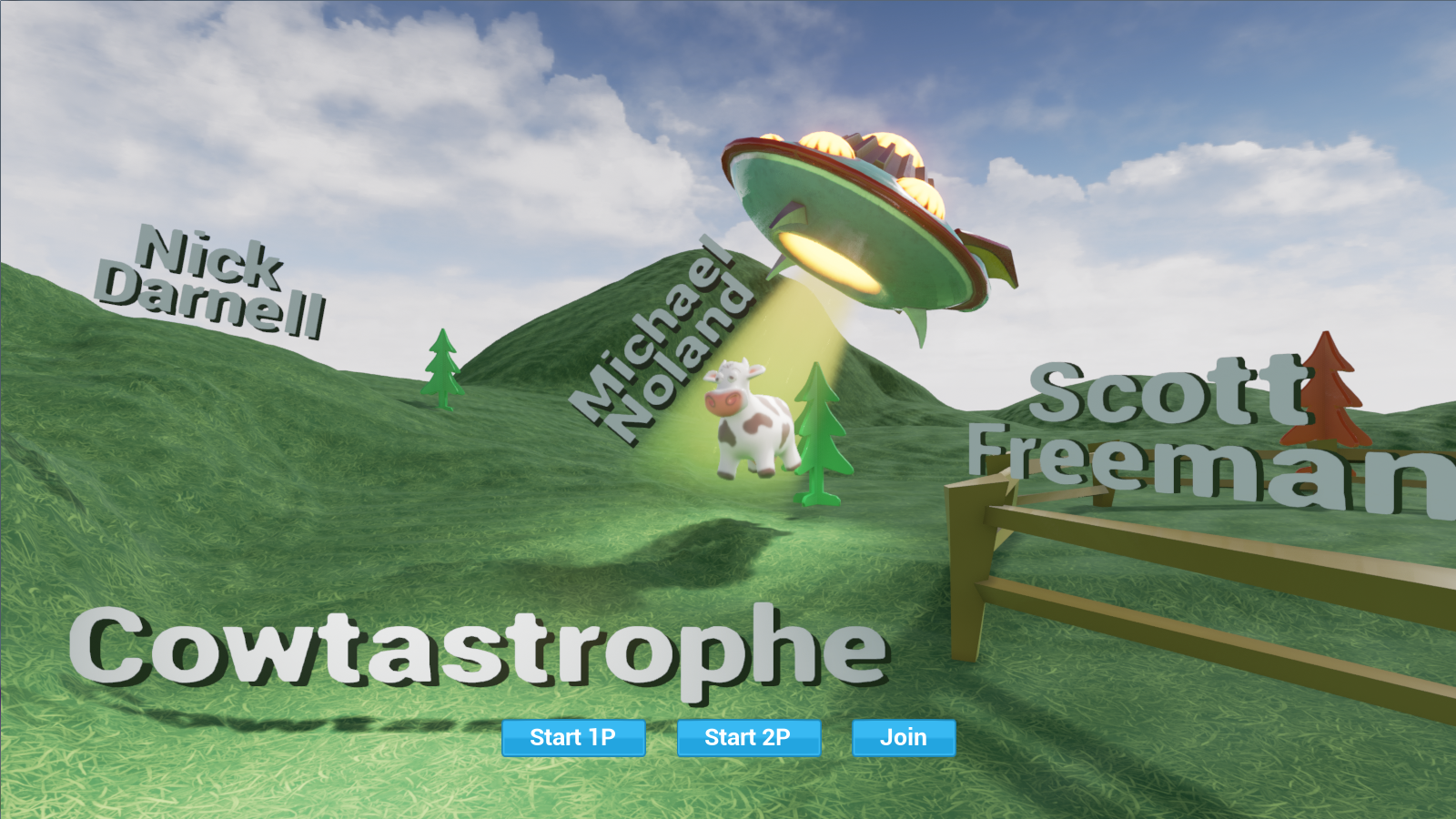
<p><img src="http://res.cloudinary.com/dirrplkr6/image/upload/v1476465720/llfsumdze3ybzr8rtme6.png" alt="Title Screen" /></p>

<h3 id="premise">Premise</h3>

<p>Overlord Phil has ordered all of his minions (that means you and up to three of your friends) to bring him cows, lots and lots of cows!</p>

<p>Be the best minion you can be and get Phil the right cow he wants. He’s a very fickle overlord with a very short attention span, so don’t dally.</p>

<iframe src="https://vine.co/v/OFPxulgKPDI/embed/simple" width="600" height="600" frameborder="0"></iframe>
<script src="https://platform.vine.co/static/scripts/embed.js"></script>

<h3 id="how-to-play">How to Play</h3>

<ul>
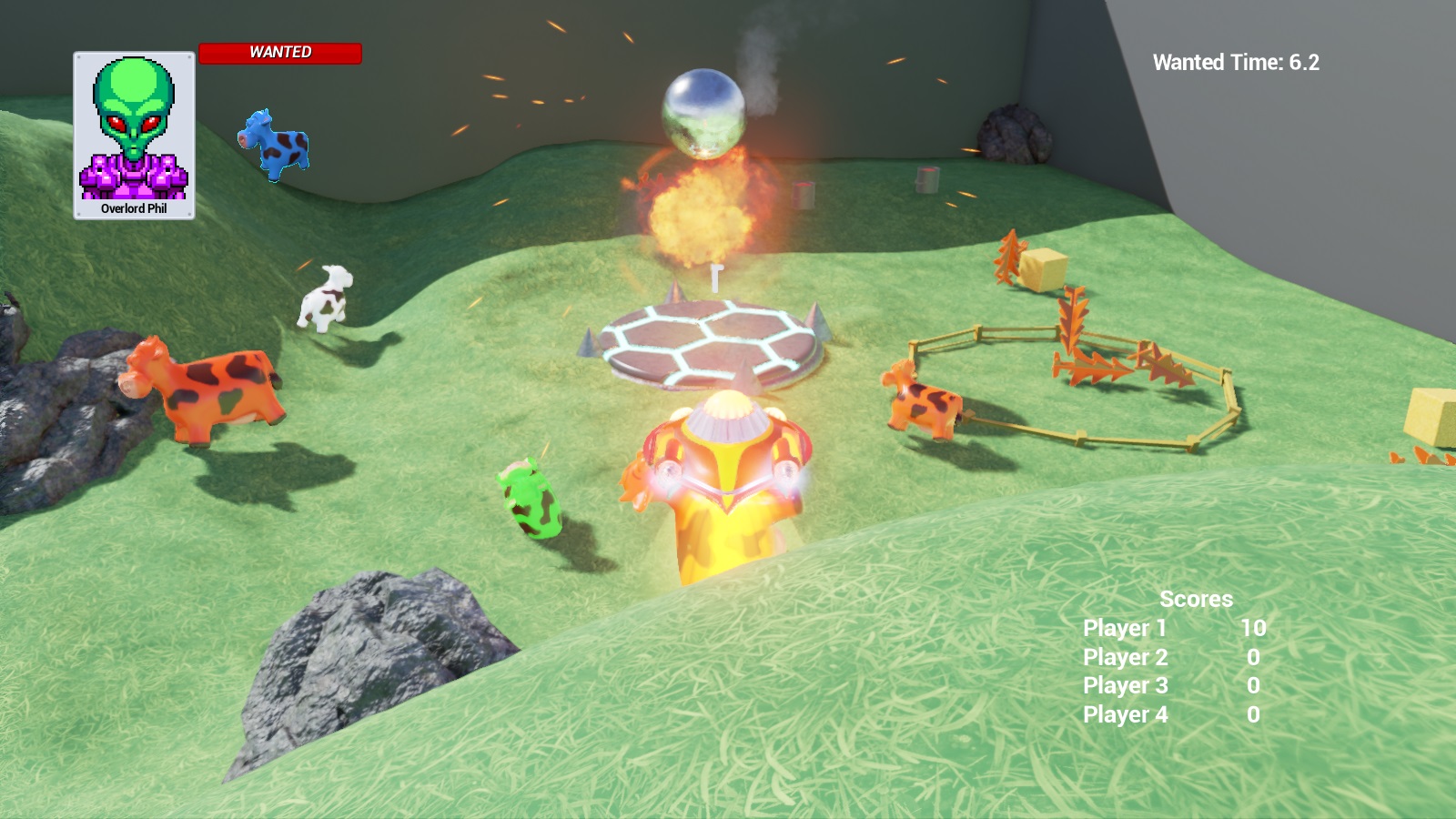
  <li>Gather cows and deposit them into the “teleporter” (marked by a hovering sphere) to gain points.</li>
  <li>The overlord is a very fickle boss, changing the desired type of cow frequently. If you fulfill his current order, you’ll get lots of points, but any old cow will keep him pleased for a bit.</li>
  <li>Feed cows hay first to fatten them up, fattened cows are worth mooore.</li>
</ul>

<h6 id="keyboardmouse">Keyboard+Mouse</h6>

<ul>
  <li>WASD to move</li>
  <li>Mouse to look around</li>
  <li>Space or Left-Mouse-Button to activate your cowscoop</li>
</ul>

<h6 id="gamepad">Gamepad</h6>

<ul>
  <li>Left Stick to move</li>
  <li>Right Stick to look around</li>
  <li>A to activate your cowscoop</li>
</ul>

<p><img src="http://res.cloudinary.com/dirrplkr6/image/upload/v1476465726/tyez9hbmczbxa8mkw14b.jpg" alt="Gameplay" /></p>

<h3 id="team">Team</h3>

<ul>
  <li><a href="/">Nick Darnell</a></li>
  <li><a href="http://michaelnoland.com">Michael Noland</a></li>
  <li>Scott Freeman</li>
</ul>

<h5 id="additional-credits">Additional credits</h5>

<p>Paint Can: <a href="http://www.blendswap.com/blends/view/14365">http://www.blendswap.com/blends/view/14365</a><br />
Kenny Space UI Theme: <a href="http://opengameart.org/content/ui-pack-space-extension">http://opengameart.org/content/ui-pack-space-extension</a><br />
Overlord Phil: <a href="http://opengameart.org/content/modular-reticulan-portraits">http://opengameart.org/content/modular-reticulan-portraits</a><br />
Lots of assets from the UE4 Content Examples project available on the UE4 Learn Tab<br />
Developed using Unreal Engine 4.6, Audacity, Blender, BFXR</p>

<h3 id="download">Download</h3>

<ul>
  <li><a href="http://ggj.s3.amazonaws.com/games/2015/01/25/2148/CowtastrophySource.zip">Full Package</a> - Includes UE4 project files</li>
  <li><a href="http://ggj.s3.amazonaws.com/games/2015/01/25/2158/Cowtastrophy.zip">Game Only</a> - Just the game, for Windows.</li>
</ul>

<p>Tested on Windows and Mac, but the packaged release is for Windows only. Multiplayer requires multiple gamepads.</p>]]></content><author><name>Nick Darnell</name></author><category term="global-game-jam" /><category term="unreal-engine-4" /><category term="cows" /><summary type="html"><![CDATA[So for the 2015 Global Game Jam we worked on a multiplayer game called Cowtastrophe. It’s a very silly game, you collect cows, some cows are worth more than others at certain times. So you’ve gota move quick.]]></summary></entry><entry><title type="html">The Fancy Game Namer</title><link href="/the-fancy-game-namer/" rel="alternate" type="text/html" title="The Fancy Game Namer" /><published>2013-12-12T00:00:00+00:00</published><updated>2013-12-12T00:00:00+00:00</updated><id>/the-fancy-game-namer</id><content type="html" xml:base="/the-fancy-game-namer/"><![CDATA[<p>So back in 2012 for the Triangle Game Jam, I threw together a simple PHP script to generate a set of game names based on the pattern Adjective Noun Verb(er) from a word bank supplied from the users.  Since then I’ve always wanted to redo it in a more reusable way.  With the Global Game Jam quickly approaching, I managed to find time this week to make that happen.  You can check it out at <a href="http://www.fancygamenamer.com/" title="Fancy Game Namer">http://www.fancygamenamer.com</a>.  It works more or less like the old PHP script I wrote, except this time you can use the official bank of words, or if you’ve got a specific set of words you want to scope it to, you can create your own word bank.</p>

<p>It sounds terribly silly, but give it a shot.  They say constraints breed creativity.  Prepare to be creative :)</p>]]></content><author><name>Nick Darnell</name></author><category term="fancy" /><category term="game" /><category term="game-jam" /><category term="generator" /><category term="global-game-jam" /><category term="project" /><category term="tool" /><category term="triangle-game-jam" /><summary type="html"><![CDATA[So back in 2012 for the Triangle Game Jam, I threw together a simple PHP script to generate a set of game names based on the pattern Adjective Noun Verb(er) from a word bank supplied from the users.  Since then I’ve always wanted to redo it in a more reusable way.  With the Global Game Jam quickly approaching, I managed to find time this week to make that happen.  You can check it out at http://www.fancygamenamer.com.  It works more or less like the old PHP script I wrote, except this time you can use the official bank of words, or if you’ve got a specific set of words you want to scope it to, you can create your own word bank.]]></summary></entry><entry><title type="html">Broken Magic Jumper Online!</title><link href="/broken-magic-jumper-online/" rel="alternate" type="text/html" title="Broken Magic Jumper Online!" /><published>2013-12-07T00:00:00+00:00</published><updated>2013-12-07T00:00:00+00:00</updated><id>/broken-magic-jumper-online</id><content type="html" xml:base="/broken-magic-jumper-online/"><![CDATA[<p>I’ve been experimenting with a little project called <a href="http://www.jsil.org/">JSIL</a> off and on, it can take compiled IL code and convert it to Javascript.  Which seemed like an interesting idea when I first learned about it, sort of like the asm.js for .Net.  This weekend, I managed to port Broken Magic Jumper, which was an XNA game jam game I made awhile back.  I had to tweak a few things that weren’t supported, but after a Saturday afternoon of banging on the code it’s working!</p>

<p><a href="http://nickdarnell.github.io/BrokenMagicJumperJSIL/Game/">http://nickdarnell.github.io/BrokenMagicJumperJSIL/Game/</a></p>

<p>It’s just as functional as the desktop version too!</p>]]></content><author><name>Nick Darnell</name></author><summary type="html"><![CDATA[I’ve been experimenting with a little project called JSIL off and on, it can take compiled IL code and convert it to Javascript.  Which seemed like an interesting idea when I first learned about it, sort of like the asm.js for .Net.  This weekend, I managed to port Broken Magic Jumper, which was an XNA game jam game I made awhile back.  I had to tweak a few things that weren’t supported, but after a Saturday afternoon of banging on the code it’s working!]]></summary></entry><entry><title type="html">The Depixelizer</title><link href="/the-depixelizer/" rel="alternate" type="text/html" title="The Depixelizer" /><published>2013-05-26T00:00:00+00:00</published><updated>2013-05-26T00:00:00+00:00</updated><id>/the-depixelizer</id><content type="html" xml:base="/the-depixelizer/"><![CDATA[<p>A few days ago <a href="http://graphicscodex.com/">Morgan McGuire</a> added a post on his blog about the absence of a good cross platform tool for depixelizing pixel art for higher resolutions purposes.</p>

<p>I’ve also faced this problem when jamming, but not wanting to invest tons of my own time into developing a native cross platform solution, compiling it on every platform, and then building installers <em>ick</em>, I thought – maybe it will work as a webtool?</p>

<p>So I scoured the net for a good implementation of the hq4x algorithm in javascript that Morgan referenced, found one on github and then built a solution around the library.  All in all, I’d say I put 8 hours into it, just finding the right javascript libraries and stitching everything together.  The more I mess with modern web tech the more impressed I am in the kinds of tools that can be built in the browser.  It’s not great for a lot of things, but it’s definitely got some advantages in the case of making cross platform simple tools that would typically be command line (unfriendly) tools.</p>

<p>If you have a chance, check out <a href="http://nickdarnell.github.io/depixelizer/">The Depixelizer</a>!</p>]]></content><author><name>Nick Darnell</name></author><category term="github" /><category term="html5" /><category term="javascript" /><category term="pixel" /><category term="pixelized" /><category term="web" /><summary type="html"><![CDATA[A few days ago Morgan McGuire added a post on his blog about the absence of a good cross platform tool for depixelizing pixel art for higher resolutions purposes.]]></summary></entry><entry><title type="html">Undead Man Lover</title><link href="/undead-man-lover/" rel="alternate" type="text/html" title="Undead Man Lover" /><published>2013-05-26T00:00:00+00:00</published><updated>2013-05-26T00:00:00+00:00</updated><id>/undead-man-lover</id><content type="html" xml:base="/undead-man-lover/"><![CDATA[<p>I should have wrote a post about this months back, but better late than never.  At the Global Game Jam this year my buddy Mike and I teamed up, with some assistance of two NC State students to create Undead Man Lover.</p>

<p>The theme this year was the sound of a beating heart.  So we created Undead Man Lover.  You play a wizard trying to transform zombies back into living humans.  But zombies love the sound of a beating heart, so they’ll attack anyone you transform.  To combat their attempts to devour your new human friends, you have spells.  But unfortunately casting a spell is a stressful affair that raises your own heartbeat, making the zombies think you are quite yummy.  You’ll have to balance transforming zombies and not attracting too much attention before the time runs out.</p>

<p>I found it extremely handy to use the mad lib database we created for the last local triangle game jam to come up with a game concept for the jam’s theme.  When all you have is the sound of a beating heart, one finds themselves creatively thinking in a very localized minima of themes and game mechanics (heart beat rythm game, suspense game with a heart beat, shooting blood as a heart, blood cell racer…etc).  But with the jam theme in mind, the series of “Adjective Noun Verb” phrases that the mad lib generator spits out gives you much more creative applications of the jam’s theme and gets you out of the creative rut.</p>

<!--includes/youtube.html begin-->
<div style="max-width:1; aspect-ratio:1.777;">
    <iframe src="https://www.youtube.com/embed/ZnHosmG1AAk?feature=oembed" frameborder="0" sandbox="allow-scripts allow-popups allow-top-navigation-by-user-activation allow-forms allow-same-origin allow-storage-access-by-user-activation" allowfullscreen="true" style="width:100%; height:100%;">
</iframe>
</div>
<!--includes/youtube.html end-->]]></content><author><name>Nick Darnell</name></author><category term="game-jam" /><category term="programming" /><category term="xna" /><category term="zombies" /><summary type="html"><![CDATA[I should have wrote a post about this months back, but better late than never.  At the Global Game Jam this year my buddy Mike and I teamed up, with some assistance of two NC State students to create Undead Man Lover.]]></summary></entry><entry><title type="html">Broken Magic Jumper</title><link href="/broken-magic-jumper/" rel="alternate" type="text/html" title="Broken Magic Jumper" /><published>2012-11-26T00:00:00+00:00</published><updated>2012-11-26T00:00:00+00:00</updated><id>/broken-magic-jumper</id><content type="html" xml:base="/broken-magic-jumper/"><![CDATA[<p>A couple of weekends ago was the 2012 <a href="http://trianglegamejam.com/" title="Triangle Game Jam website">Triangle Game Jam</a>. Our theme of the jam was to generate game titles by madlibs: everyone contributed a list of 5 adjectives, 5 nouns, and 5 verb stems, and a program generated random game names from them. From there, we pitched ideas based on the titles and formed teams.</p>

<p>With nearly 100 combinations of titles generated I ended up pitching a concept for #14 – Broken Magic Jumper.  Although a lot of people initially voted that they would like to see the game made, I was the only one on my team by the time everyone had finished picking teams.</p>

<h3 id="the-original-pitch">The Original Pitch</h3>

<p>The original pitch was that you’re a wizard solving a jumping platformer with spells and there are broken magic areas in the world that change a spells effect, and so you have to solve the puzzle by using the right combination of spells.</p>

<h3 id="what-actually-got-made">What Actually Got Made</h3>

<p>The game I ended up making was a bit of a departure from the initial concept, it took until about early Saturday afternoon to nail down the exact mechanics, all the while I was just getting the basics of a jumping platformer working and correctly loading levels from <a href="http://www.mapeditor.org/">Tiled</a>.</p>

<h6 id="the-story">The Story</h6>

<p>The wizard in charge of protecting the Jump Crystal – the source of all jump powers in the universe, has dropped and shattered the crystal.  He must collect and use the jump crystal shards to find and piece the crystal back together.</p>

<h6 id="the-game">The Game</h6>

<p>Each type of jump shard will grant the possessor a special jump power – but you can only have one at a time.  Use your jumping and problem solving skills to use the shards in the right order to solve each puzzle.  I’ve uploaded final version of the game to play.  Both the keyboard and Xbox controller will work.  The links are below.  Have fun!</p>

<!--includes/youtube.html begin-->
<div style="max-width:1; aspect-ratio:1.777;">
    <iframe src="https://www.youtube.com/embed/ouiH2Azj3RU?feature=oembed" frameborder="0" sandbox="allow-scripts allow-popups allow-top-navigation-by-user-activation allow-forms allow-same-origin allow-storage-access-by-user-activation" allowfullscreen="true" style="width:100%; height:100%;">
</iframe>
</div>
<!--includes/youtube.html end-->

<h3 id="downloads">Downloads</h3>

<ul>
  <li><a href="http://www.files.nickdarnell.com/BrokenMagicJumper.zip">Broken Magic Jumper</a></li>
  <li><a href="http://www.microsoft.com/download/en/details.aspx?id=20914">XNA 4 Redistributable Package</a> (needed to play the game)</li>
</ul>

<h6 id="notes">Notes</h6>

<p>Additional content was used under licenses from <a href="http://forums.tigsource.com/index.php?topic=8970.0">Oryx</a>, <a href="http://opengameart.org/content/classical-ruin-tiles">Surt</a>, <a href="http://opengameart.org/content/rotating-crystal-animation-8-step">Qubodup</a>, <a href="http://incompetech.com/music/royalty-free/">Kevin MacLeod</a>, and <a href="http://www.freesound.org/">freesound.org</a>.</p>]]></content><author><name>Nick Darnell</name></author><category term="awesome" /><category term="c" /><category term="game" /><category term="game-jam" /><category term="triangle-game-jam" /><category term="xna" /><summary type="html"><![CDATA[A couple of weekends ago was the 2012 Triangle Game Jam. Our theme of the jam was to generate game titles by madlibs: everyone contributed a list of 5 adjectives, 5 nouns, and 5 verb stems, and a program generated random game names from them. From there, we pitched ideas based on the titles and formed teams.]]></summary></entry></feed>